Hold the Line: Part 4
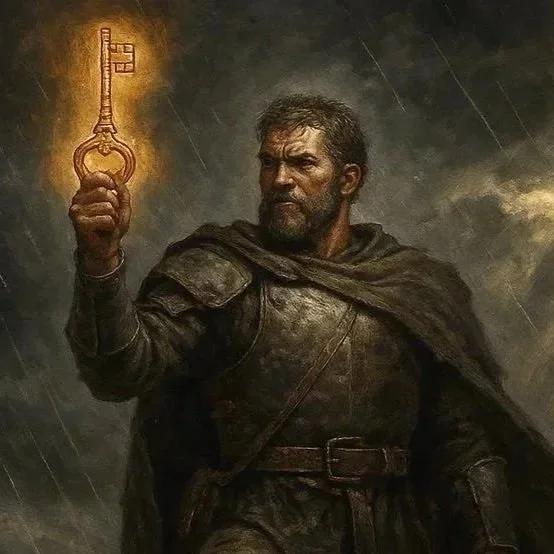
Death is the great equalizer. Rich or poor, powerful or weak, celebrated or forgotten, every man faces the same inevitable end. Empires crumble and legacies fade. Even the mightiest conqueror eventually succumbs to the grave.
Death appears to have the final word. Except it doesn’t.
In the third strophe of St. Paul’s cosmic hymn in Colossians 1:18b-20, we encounter the earth-shattering truth that demolishes every fear you carry about mortality: Jesus Christ is πρωτότοκος ἐκ τῶν νεκρῶν (prototokos ek ton nekron), the firstborn from the dead.
Christ didn’t merely survive death or experience a mystical vision. He obliterated death itself, rising bodily from the grave as the first warrior through enemy lines. And because He broke through, the path is open for you.
The Beachhead Against Death
“He is the beginning, the firstborn from the dead, that in everything He might be preeminent.” (Colossians 1:18b)
St. Paul deploys the term ἀρχή (archē)—“beginning” or “origin”—like a tactical designation. Christ isn’t simply one among many who will be raised. He’s the beachhead, the first strike, the origination point of the entire resurrection campaign.
When the Father raised Jesus from the dead on that first Easter morning, He didn’t restore the old order. He invaded it. The resurrection wasn’t resuscitation, bringing a corpse back to the same mortal existence only to die again later, like Lazarus. This was a transformation. This marked the emergence of an entirely new creation, and Christ led the way.
St. Paul hammers this home with πρωτότοκος ἐκ τῶν νεκρῶν (prototokos ek ton nekron), “firstborn from the dead.” Just as “firstborn over all creation” in verse 15 signified Christ’s supremacy over everything that exists, “firstborn from the dead” establishes His absolute authority over death itself and the resurrection order that flows from His victory.
Then comes the purpose clause that should stop you cold: ἵνα γένηται ἐν πᾶσιν αὐτὸς πρωτεύων (hina genētai en pasin autos proteuōn), “in order that He alone might be preeminent in everything.”
The Greek construction leaves zero room for negotiation. The word αὐτὸς (autos) appears with emphatic force: He Himself. This isn’t shared authority or coequality with other powers. Christ alone holds absolute supremacy over all reality, including the one enemy that defeats every other power in this world: death.
This truth demolishes every competing claim for your ultimate allegiance. Your career cannot offer you preeminence beyond the grave. Your achievements won’t outlast death. Your reputation will fade within a generation. Political movements rise and fall. Philosophical systems come and go. But Christ’s preeminence is eternal and absolute because He conquered the final enemy.
The question you must answer is brutally simple: Does Christ hold preeminence in everything in your life, or only in the religious compartment you’ve carved out for Sunday mornings?
All the Firepower in One Man
“For in Him all the fullness of God was pleased to dwell.” (Colossians 1:19)
St. Paul now reveals the strategic foundation for Christ’s cosmic supremacy. The phrase can be rendered appropriately: “For God in all His fullness was pleased to dwell in Him.”
Unpack what the Apostle just said. The term πλήρωμα (plērōma) means “fullness” or “completeness.” This isn’t just one of many divine emanations floating around the cosmos. This is all of God—completely, permanently, bodily—dwelling in the person of Jesus Christ.
The verb εὐδόκησεν (eudokēsen) reveals the Father’s battle plan: He chose to house all His firepower in one Man. Not reluctantly, nor as an emergency Plan B when humanity spiraled out of control. With deliberate, sovereign pleasure, from before the foundation of the world, the Father resolved that all His fullness would dwell bodily in the Son.
This truth was a direct blow against the Colossian heresy that was infecting the early Church. False teachers were spreading lies: Jesus was merely one of many spiritual intermediaries between God and man. You needed additional secret knowledge to reach God. You needed mystical experiences and ascetic practices. The material world—including the human body—was inherently evil, so God could never truly inhabit flesh.
St. Paul obliterates these lies with surgical precision. All the fullness of God dwells in Christ. Not part of God, nor an aspect or emanation of God. All of God, completely and permanently, in bodily form.
The verb κατοικῆσαι (katoikēsai) drives the point home—“to dwell” or “to make one’s home” permanently. This isn’t a temporary visit or mystical theophany like the burning bush, but the eternal union of divine and human natures in the one person of Jesus Christ. The fullness that dwelt in Him during His earthly ministry continues to dwell in His glorified body now and forever.
For the Catholic man struggling to find meaning in ordinary existence, this changes everything. You aren’t searching for God in the abstract. You’re not trying to achieve union with an impersonal cosmic force through meditation techniques or spiritual disciplines. You’re relating to a Person—fully God and fully man—who took on human flesh, experienced human suffering, died a human death, and rose in a glorified human body that He retains forever.
Your body matters because God chose to inhabit a body. Your humanity isn’t an obstacle to holiness but the very vessel God chose to reconcile the world to Himself. The ordinary struggles of embodied existence—hunger, fatigue, temptation, suffering, death—aren’t outside God’s experience. He assumed them, sanctified them, and conquered them.
Peace Purchased with Blood
“And through Him to reconcile all things to Himself, making peace by the blood of His cross—whether things on earth or things in heaven.” (Colossians 1:20)
St. Paul now reaches the climax of the hymn, the ultimate purpose for which the fullness of God dwelled in Christ: καὶ δι᾽ αὐτοῦ ἀποκαταλλάξαι τὰ πάντα εἰς αὐτόν (kai di autou apokatallaxai ta panta eis auton), “and through Him to reconcile all things to Himself.”
The compound verb ἀποκαταλλάξαι (apokatallaxai) isn’t your standard diplomatic reconciliation. The prefix intensifies the meaning: this is a complete restoration to the original state. Not merely establishing cease-fire terms between hostile parties. This is the complete restoration of the harmony that existed before sin shattered the created order.
Notice the scope: τὰ πάντα (ta panta), “all things.” St. Paul isn’t describing individual soul-salvation alone, though that is certainly included. He is describing universal reconciliation: the restoration of all creation to right relationship with its Creator.
Everything broken by sin is being restored through Christ:
Human relationships with each other
The human relationship with God
The relationship between humanity and creation
The corruption that entered the physical universe itself
All of it reconciled through Christ.
The means of this reconciliation is specified with brutal clarity: εἰρηνοποιήσας διὰ τοῦ αἵματος τοῦ σταυροῦ αὐτοῦ (eirēnopoiēsas dia tou haimatos tou staurou autou), “by making peace through His blood shed on the cross.”
The word εἰρηνοποιήσας (eirēnopoiēsas) means literally “peace-making.” But this isn’t peace achieved through negotiation, compromise, or mutual understanding. This is peace purchased with blood.
St. Paul deliberately pairs two prepositional phrases to hammer home the method: δι᾽ αὐτοῦ (di autou), “through Him,” and διὰ τοῦ αἵματος (dia tou haimatos), “through the blood.” Reconciliation comes through Christ personally, and specifically through His blood shed on the Cross.
There’s no reconciliation apart from the Cross, and no peace with God bypasses Calvary. There’s no spiritual path that circumvents the scandal of divine blood spilled on Roman wood.
The Cross wasn’t a martyrdom that spiraled out of control. It was the deliberate means by which God chose to reconcile all things to Himself. The Son of God, in whom all the fullness of deity dwells, willingly submitted to torture and execution, shedding His blood to make peace between sinful humanity and a holy God. This truth confronts you with uncomfortable questions you cannot dodge.
Have you tried to construct a version of Christianity that bypasses the scandal of the Cross? Do you prefer a therapeutic Jesus who affirms your choices rather than a crucified Savior who calls you to die to self? Have you domesticated the faith into a system of moral improvement and self-actualization, stripped of the blood, suffering, and sacrifice that purchased your redemption?
The Cross reveals both the depth of your sin and the extent of God’s love. Your reconciliation to God was so costly that it required the death of God’s own Son. Yet God’s love for you was so extravagant that He paid that cost willingly, without hesitation, without reserve.
You cannot minimize your sin without diminishing God’s love. And you cannot magnify God’s love without confronting the horror of what your sin required.
St. Paul concludes by emphasizing the cosmic scope one final time: εἴτε τὰ ἐπὀ τῆς γῆς εἴτε τὰ ἐν τοῖς οὐρανοῖς (eite ta epi tēs gēs eite ta en tois ouranois), “whether things on earth or things in heaven.”
Nothing lies outside the reach of Christ’s reconciling work. Every dimension of reality—earthly and heavenly, visible and invisible, material and spiritual—is being brought back into right relationship with God through the blood of the Cross.
Your Marching Orders
St. Paul’s cosmic hymn in Colossians 1:15-20 is not abstract theology for academic discussion. This is wartime intelligence for men living in a broken world, facing real temptations, struggling with genuine doubts, and confronting the inevitability of death.
Let the Apostle’s words be your field briefing:
He is the image of the invisible God,
The firstborn above all creation.
For in Him all things were created,
In the heavens and on the earth,
Whether thrones or dominions
Or principalities or powers.
All things through Him alone were created and for Him.
And He alone is supreme above all things.
All things hold together in Him.
And He alone is the head of the Body, the Church,
In that He is the beginning,
The firstborn from the dead,
That in everything He might be preeminent.
For God in all His fullness was pleased to dwell in Him,
And to reconcile all things unto Himself alone,
By making peace through His blood shed on the cross,
Whether on the earth or in the heavens.
Christ is preeminent over creation because He made it. He’s preeminent over the Church because He’s her Head. He’s preeminent over death because He conquered it. He’s preeminent in reconciliation because He purchased it with His own blood.
The question isn’t whether Christ is preeminent. He is. The question is whether you will acknowledge His preeminence in every area of your life and submit to His lordship.
Death is coming for you. That’s not pessimism but battlefield reality. The statistics on mortality remain stubbornly consistent at 100%. Every man dies. But because Christ rose as the firstborn from the dead, death doesn’t have the final word over you.
Your body will die. But it will also rise. Your earthly life will end. But your eternal life has already begun in Christ.
So live like a man who knows how the war ends. Live like someone reconciled to God through the blood of the Cross. Live under the headship of the One who holds all things together and in whom all the fullness of God dwells.
He is preeminent. Let Him be preeminent in you.
YOU WERE BORN FOR THIS FIGHT.
The battle is real. The Dragon is relentless. But Christ has given you the weapons to win.
📖 Apocalypse Key reveals the enemy’s playbook hidden in Revelation—not as distant prophecy, but as present-day intelligence.
📖 Vigilant trains you through six weeks of formation to see clearly, stand firm, and strike back.
St. Michael didn’t negotiate. Neither should you.
